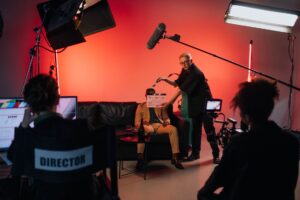


Every actor who spends enough time on set starts watching the wrong things. They stop watching their scene partner and start watching the monitor, the lens choice, the way a first assistant director keeps a day from collapsing. Florence Pugh has had more chances than most to study all of it from inside the frame. In roughly a decade she has worked under Carol Morley, William Oldroyd, Stephen Merchant, Ari Aster, Greta Gerwig, Olivia Wilde, Sebastián Lelio, Christopher Nolan and Denis Villeneuve, among others.
No directorial debut has been announced, and nothing here should be read as a confirmed project. But the pattern of her career points toward the director’s chair, and it is easier to see in the choices she makes around the work than in any press release. The ambition is taking shape quietly, in who she works with, how she works with them and what she builds on her own time.
A Film School With a Call Sheet
Consider the range of directing styles she has had to adapt to. Ari Aster’s Midsommar demanded emotional extremity inside a tightly controlled visual design, where every flower crown and mural was placed for a reason. Greta Gerwig’s Little Women ran on the opposite energy: overlapping dialogue, warmth and a sense of play, with an ensemble that had to feel like a real family. Moving between those two sets is a lesson in how differently a director can build a world.
Then there is the scale question. Black Widow and Thunderbolts* taught her how a studio machine runs, with its stunt coordination, effects pipelines and reshoot logic. Oppenheimer and Dune: Part Two put her inside two of the most exacting large-format productions of recent years, even in supporting roles. An actor on a Marvel set sees how hundreds of people are marshaled toward one shot. An actor on a Nolan set sees how a filmmaker can insist on doing things the hard way and make it work.
The smaller films matter just as much. Lady Macbeth was a lean, controlled period piece that put her at the center of nearly every frame. The Wonder was a quiet, claustrophobic drama in which tone mattered more than plot. Directors who work at that scale make choices about restraint, and restraint is hard to teach. Anyone planning a first feature would be wise to learn it from the inside.
The Clues Outside the Film Set
Her lockdown cooking videos, shot at home and posted to Instagram, were easy to dismiss as pandemic-era charm. They also showed an instinct for tone, pacing and audience: a persona that felt unpolished but was clearly shaped, with a consistent voice from clip to clip.
A director’s first job is to make something feel like itself from start to finish. Pugh has shown, in small formats, that she knows how to do that without a crew telling her what the scene needs.
What a Pugh-Directed Film Might Actually Look Like
Speculation is cheap, but her filmography gives it some structure. She is drawn to stories in which women are watched, judged or contained, and then refuse to behave. Lady Macbeth, Midsommar, The Wonder and Don’t Worry Darling all sit on that fault line. A debut behind the camera would probably start there, with a character under pressure from a community, a family or an institution, and a performance built on small physical choices rather than speeches.
The harder question is craft. Acting and directing use different muscles. An actor controls one performance, while a director controls rhythm across two hours: where a scene breathes, where it gets cut short, how the sound design fills a silence. The usual route for actors who cross over runs through short films, producing credits or a small first feature with a trusted cinematographer and editor. That route lets a new director make mistakes cheaply, which matters when the person in question is famous enough that every stumble becomes a headline.
Her profile cuts both ways. A name like hers can raise financing and attract a strong crew, but it also invites a skeptical reading of any debut. Actors-turned-directors are judged harder, not softer, and the ones who have earned respect tended to pick material that suited their strengths rather than something designed to prove range. Pugh’s public persona is blunt and funny, and she has never seemed afraid of an awkward moment. That matters, because directing is mostly a long run of awkward moments handled calmly.
The detail worth watching is not an announcement but a credit: who she brings in as editor and cinematographer when she does eventually make something of her own.
Frequently Asked Questions
Has Florence Pugh announced a directorial debut?
No directorial debut has been announced as of this writing. The article looks at patterns in her career that suggest an interest in working behind the camera.
Which directors has Florence Pugh worked with?
Her collaborators include Ari Aster, Greta Gerwig, Olivia Wilde, Christopher Nolan, Denis Villeneuve, Sebastián Lelio and William Oldroyd.
What kind of film might Florence Pugh direct?
Her filmography suggests a character-driven story about a woman under social or institutional pressure, built on restrained, physical performances.